
Banias – a turning point for Jesus
As a 26 year old, to my surprise (but it was after 21 years of non-stop formal education) I took the year off from my pastoral studies, picked fruit to earn enough money, then spent 6 months in Europe including 7 weeks in Israel. The climate was just like SA where I had been working, and I suddenly discovered that the geography of the Holy Land was important. This turning point in the gospel comes right at the northernmost part of the country, just below Mt Hermon, as far away from Jerusalem as you could get. Here the Jordan river, an abundance of water, tumbles straight out of a broad crack at the bottom of a mountain. A picnicking family assured us it was the cleanest water in Israel, so we drank, and accepted their kind offer of their last few pitta breads, as there was no shop within miles. Then we found an out of the way place to sleep, before walking out the next morning, and then bussing to the coast and food.
Jesus didn’t starve – there was a thriving modern Roman built city back then. Here, where the life waters of Israel start, Jesus tells his disciples what sort of Messiah he will be, and starts his return journey that will end at Jerusalem and the cross. He will be life-giving for the whole world.
Peter and Rome
We jump now to Rome. The Gospel of Mark was most likely written there, just after the persecutions of Nero. In the year 49, the whole Jewish community was expelled from Rome, because of internal squabbling between those who said Jesus was the Messiah, and those who refused to accept that. In 54, newly ascended Nero allowed Jews to return to the Jewish quarter, swampy land on the wrong side of the Tiber. That included Peter, and later Paul who was under house arrest.
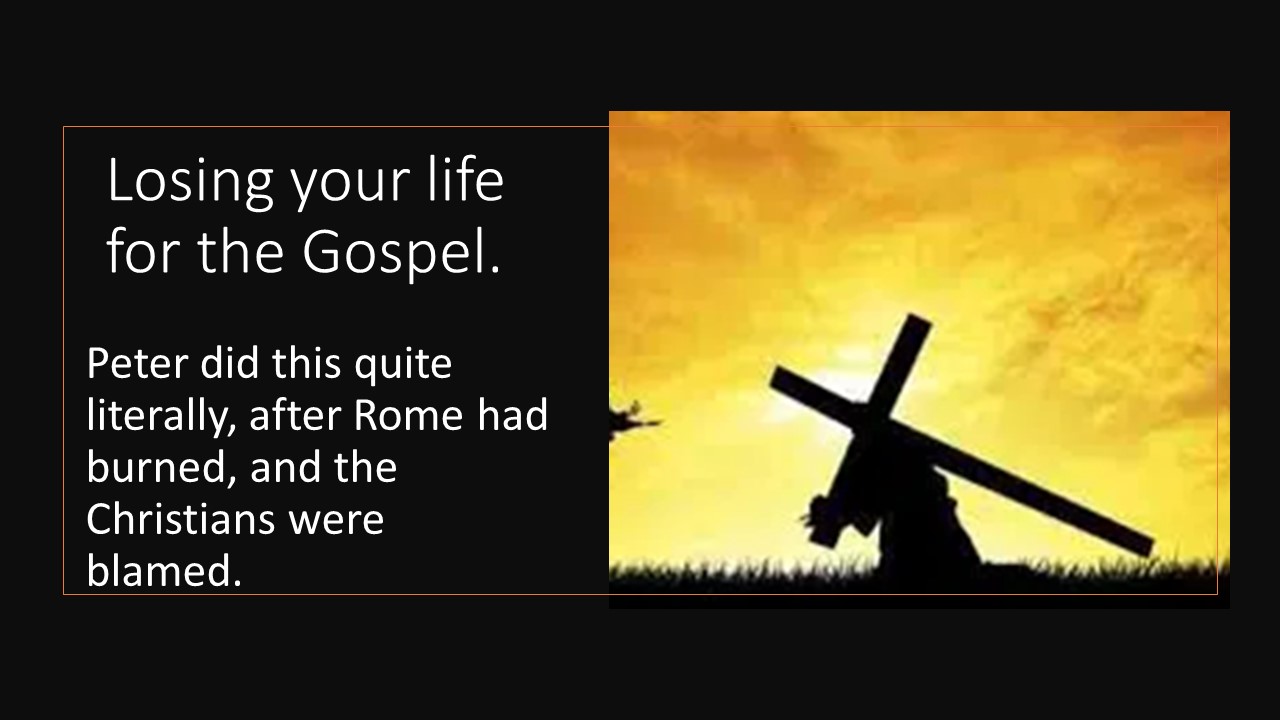
Ten years after Nero began, a massive fire broke out in Rome. It burned for 5 days, was put out, then reignited for another 2 days. Most of the city was destroyed, including the homes of the extremely rich and powerful. Nero had earlier proposed a massive re-building program and suspicion soon fell on him. The Jewish community in their swampy land was untouched, so Nero blamed them for starting the fire. The Jewish people dreaded yet another eviction, and it appears that a small group went to Nero saying the Christian Jews had started the fire. Nero sent in the soldiers who brutally demanded that any household with a Christian was to be killed. If they insisted that no Christians were in their house, they had to name another household that did include Christians. Some of the Christians were actually used as human torches for Nero’s lavish banquets. An horrific time. Both Paul and Peter were killed. Early tradition has Peter leaving Rome to save his life, but then returning, realising he needed to stay with Jesus’ people, no matter what.
Read these verses in that light, and they hardly become easier. ‘Deny yourself, take up your cross and follow me. Act to save your life, and you will lose it. Lose it for me, and for the gospel, and you will gain everything.’
But there is good news here, and Peter is the heart of it. Mark got his gospel from the stories and teaching of Peter. I think it is profound that Peter allowed himself to be shown in a poor light. Jesus rebuked Peter and said, ‘Get behind me Satan,’ when Peter tried to tell Jesus he could not be a suffering Messiah. Later, he denies knowing Jesus. How many modern leaders allow themselves to be shown in a bad light? But the recently martyred Peter is shown in this gospel as having to be seriously corrected by Jesus at least twice, and he was willing for Christians around Rome, and Christians today to know that. He learnt from being corrected. He learned to entrust his very life to Jesus, for the sake of the gospel. And finally, when he had a choice of leaving, keeping alive and starting again or staying, he chose to stay, and to share the pain and hurt, even to the point of losing his life, with those Christians who were being killed.
Grace to learn from mistakes
Part of the good news from Peter is – we can get things wrong, badly wrong sometimes, but God is patient with us, and we do learn, and we do grow, and we do what needs to be done. And all the time, whether we learn quickly and easily, or slowly and it’s hard, we are covered in the grace, the love, the forgiveness and the new life of Christ.
The gospel is the powerful good news that Jesus is with us, even into death, and that God’s final word is always resurrection, new life, hope. There are plenty of times, when it is the right thing to move away from something that hasn’t worked, actually moving away physically to make a new start or be safe, or moving away in other senses. We make a decision not to keep pursuing something or someone that hasn’t worked. We make a choice to move on and leave a situation behind, rather than just go round and round inside it. We make a choice not to keep covering over or constantly excusing someone else or carrying them when they refuse to carry themselves.
The grace of faithful staying power
There are other times to stay with a situation. Taking up your cross means following through on things that aren’t easy, or that you don’t want to do but are vital. When you choose to live with what is and to forgive life, for not being what it should or could be – that is powerful. And you choose, trusting that God is with you, and will give you strength, and that it is the right thing to do. And in that there is life, somehow life that is rich and true.
May we all receive courage and encouragement, from Jesus, from Peter, and from the host of others who have chosen the hard road, for the sake of life, for the sake of love, for the sake of goodness, for the sake of faith.
And in that journeying, may we all receive life.
