A difficult pregnancy and difficult twins. Esau and Jacob.

By mmayer
Genesis 25:19-34

Here is the story of the family line of Abraham’s son Isaac.

Abraham was the father of Isaac. Isaac was 40 years old when he married Rebekah. She was the daughter of Bethuel, the Aramean from Paddan Aram. She was also the sister of Laban, the Aramean.

Rebekah couldn’t have children. So Isaac prayed to the Lord for her. And the Lord answered his prayer. His wife Rebekah became pregnant. The babies struggled with each other inside her. She said, “Why is this happening to me?” So she went to ask the Lord what she should do.

The Lord said to her,

“Two nations are in your body.
Two tribes that are now inside you will be separated.
One nation will be stronger than the other.
The older son will serve the younger one.”

The time came for Rebekah to have her babies. There were twin boys in her body. The first one to come out was red. His whole body was covered with hair. So they named him Esau (Red). Then his brother came out. His hand was holding onto Esau’s heel. So he was named Jacob (Heel grabber). Isaac was 60 years old when Rebekah had them.

The boys grew up. Esau became a skilful hunter. He liked the open country. But Jacob was content to stay at home among the tents. Isaac liked the meat of wild animals, so Esau was his favourite son. But Rebekah’s favourite was Jacob.

One day Jacob was cooking some stew. Esau came in from the open country. He was very hungry. He said to Jacob, “Quick! I’m starving! Let me have some of that red stew!” That’s why he was also named Edom (Red).

Jacob replied, “First sell me the rights that belong to you as the oldest son in the family.”

“Look, I’m dying of hunger,” Esau said. “What good are those rights to me?”

But Jacob said, “First promise to sell me your rights.” So Esau promised to do it. He sold Jacob all the rights that belonged to him as the oldest son.

Then Jacob gave Esau some bread and some lentil stew. Esau ate and drank. Then he got up and left.

So Esau didn’t value the rights that belonged to him as the oldest son….


When Esau was 40 years old, he got married to Judith. She was the daughter of Beeri the Hittite. Esau also married Basemath. She was the daughter of Elon the Hittite. They made life bitter for Isaac and Rebekah.

Rebekah in Genesis 24 is an ultra-competent, confident young woman, ready to accept marriage to Isaac. God had promised Abraham and Sarah land, their own child, and blessings to the whole world through their descendants. Twenty years of not getting pregnant would have taken its toll on Rebekah’s confidence. I don’t know what they were doing prayer wise for those 20 years but it says that Isaac prayed, and God answered. Rebekah became pregnant, and it was a very difficult pregnancy. So she prays her distress, and gets the word from God, “You are carrying twins. They’ll become two nations. They’ll fight. The older will serve the younger.” The twins are born. The first, Esau, is red all over. The second is born grabbing Esau’s heel and not letting go, so he gets called Jacob (Heel grabber).

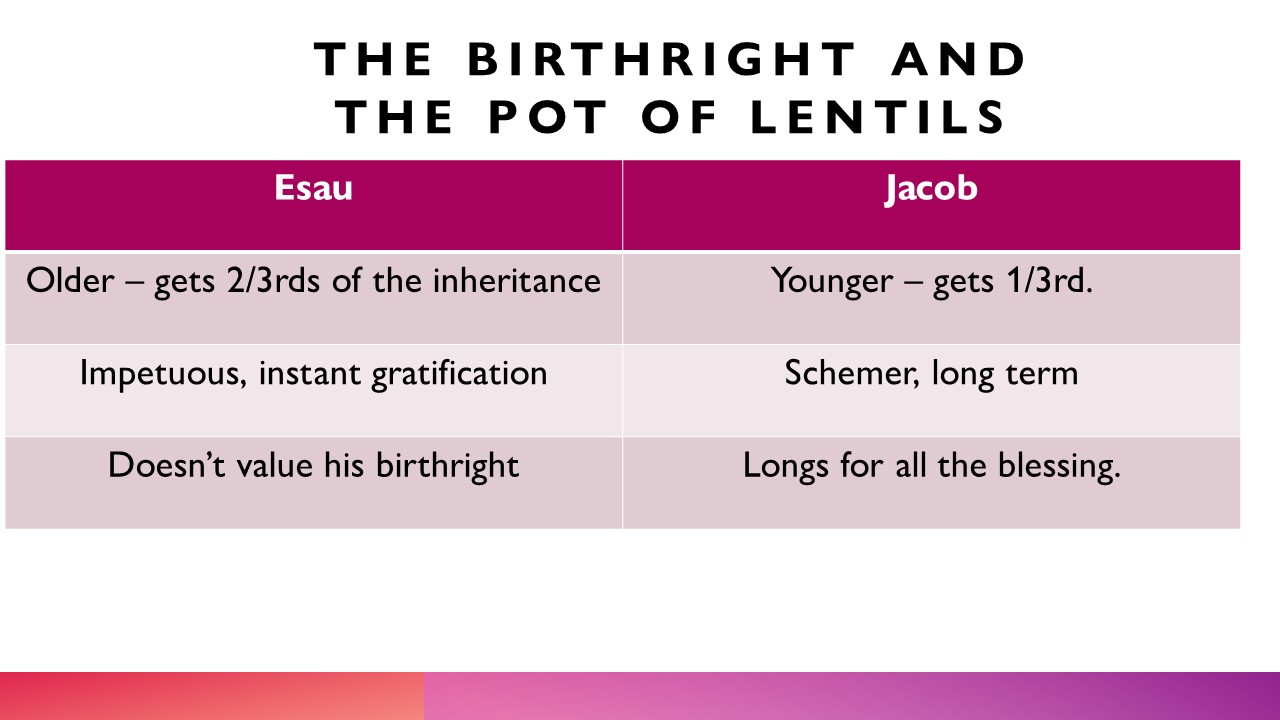
The two boys and completely different. Esau loves being outdoor and hunting. He is Isaac’s favourite. Jacob loves being around the home tents. He is Rebekah’s favourite. Esau is totally out there, and you know exactly what he is thinking and feeling. Jacob is more restrained, more of a long term planner.

When Esau comes in from a day’s hunting, totally exhausted, and he smells the yummy red lentil stew Jacob is cooking, he is so unreal. ‘Quick, give me some of that. I’m dying.’

‘Sure’ Jacob replies. ‘I’ll give it to you, if you give me your birthright as the first born.’

‘What good is having two thirds of everything later when Dad dies, if I am dying right now. Done!’

The scripture simply comments that Esau did not value his birthright.

So, two sons, two very different characters, both loved by God. Being challenged as a parent is nothing new. Raising children who are very different – nothing new. Trusting that God redeems both our mistakes and our best intentions – nothing new. Discovering that God is with us in our difficult ‘pregnancies‘ (the new God things coming to life in and through us) – nothing new. Grace is grace, back then, and now. Forgiveness is still vital today.

Accessibility