
Ephesians 2: 11-22 God chooses others as well as me.
I choose you! That was the theme last week. But, God says, “I also choose others, who aren’t from your tradition or background or way of thinking. I am breaking down any barriers between you, through Jesus’ death on the cross.’ They need forgiveness, just as much as you do. This morning we will briefly look at how God’s Old Testament people saw themselves, and who they thought was in with God. We’ll touch on how the early church people dealt with this, then we will do a sideways jump to look at service learning in schools, and that will give us some ways to look at ourselves, and how we can connect, in Christ, with those who are different from us.
God chose the people of Israel to be his people. He chose to work through them, so that they would be a light to the world. He wanted them to be the pin-up, poster nation. So that other nations would be drawn into loving God. He wanted them to shine out, to stand out from their neighbours, so that people would look at them and say, ‘There is something really special about them. It must be their God. I want to be part of it.’ When you read through the Old Testament, looks for all those places where a foreigner sees that faith and joins the people of God. Some of them appear in Jesus’ family tree. Rahab from Jericho. Ruth from Moab.
But somewhere along the line, after the shock of losing their land and their temple, the Jewish people moved from seeing the Law as gift, guide and a help, and turned into a performance that earned God’s approval. Non-Jews didn’t have the Law, so there was little hope for them. A very tight, narrow picture of God, and who is in, and who is out.
Christ breaks down dividing walls.
Paul writes about the gap between Jews and non-Jews in his time, using very strong language: separated from Christ, excluded from being part of God’s chosen people, without hope and without God.
Think of people who live on the coast here – that would easily describe many: separated from Christ, not knowing where to go for hope and purpose and meaning.
Back to the early church. They had to work out the tensions between 2 different groups of people. They had Jewish people brought up to keep God’s Law is the sign of belonging. Now they had non-Jews, who weren’t keeping that Jewish life-style. Did they have to live like Jews – sign up to circumcision and keeping the Sabbath and everything else? The first ever church synod, at Jerusalem in Acts 15 determined that non Jews did not have to keep Jewish laws, but set minimum standards that would allow Jews and non-Jews to worship and work together happily. You can hear Paul, in his various letters having to battle those who wanted to load non-Jews with all the law. Paul kept focussing on grace, the free gift of forgiveness in Christ, and then showing love for neighbour and God as the response.
Service learning helps us to see others differently.
Now, let’s do our big sideways jump to service-Learning. I believe there are important lessons for us here, as we seek to reach out and connect with non-Christians. Those of you who have done Asian Focus trips, sharing with Lutherans overseas will get this.
Service learning is about helping students to go beyond the ‘let’s support a worthwhile cause and have a fundraising activity.’ It’s nice to spend a little extra on some nice food, or a free dress day and it can make people feel good, but it doesn’t really change anything. It doesn’t grow a much deeper sense of serving others, because that is what Christ does for us.
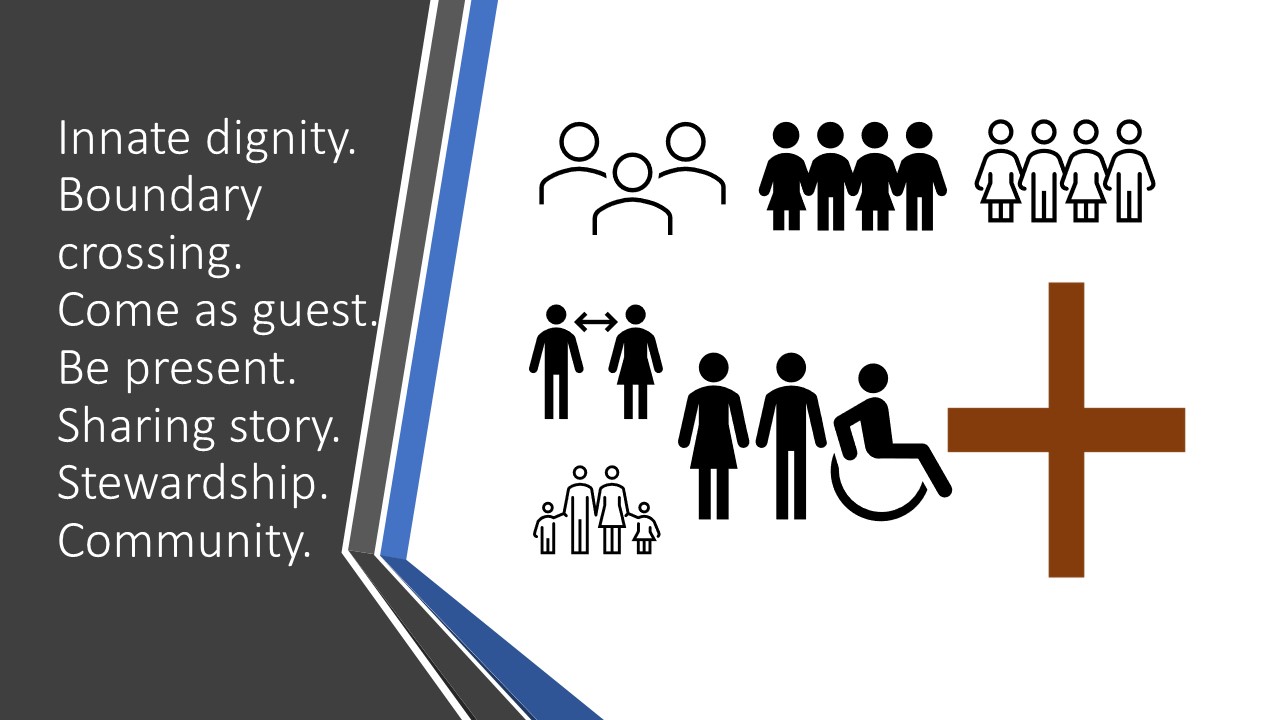
- Innate Dignity/respect
Every person has God-given value and worth. God loves each person unconditionally and completely and has gifted each person uniquely. God’s love invites us to honour the dignity of all with whom we interact.
- Boundary Crossing
When we serve others who differ from ourselves in some way, we step over boundaries and enter a new space where WE become the other. We have a greater awareness of our own cultural biases and perspectives that shape our thinking.
- Come as Guest
When we step over boundaries, we come as a guest. We come gently and respectfully into another’s space. A guest comes hospitably into the life of the host. It is an honour to come as guest.
- Presence
Presence is demonstrated by our attentiveness to the situation and the other person once we come. We actively listen. We are present for the person and the relationship. Presence is being a fellow-pilgrim, not a tourist. We walk in solidarity together.
- Story
Every person has a story. Every community has a story. God has a story to share with humankind. Stories are treasured gifts that reveal wisdom and grow empathy. When stories are shared, we humbly listen, demonstrating our respect for the story and the storyteller. We encourage the voices of all to be heard.
- Stewardship
We investigate the nature of God’s world, God’s love for the world and the responsibility people have in nurturing all of creation. It begins by fostering a sense of wonder, beauty and fragility of planet earth and of all creation. Stewardship provides an opportunity to explore the interdependence of all life on earth; key to wise efforts towards social, financial and environmental sustainability.
- Community
Relationships are integral to our identity. People have been created by God for relationship with God and with one another. Every person has multiple roles and responsibilities. Mutual respect, collaboration, reciprocity and social responsibility are central to the well-being of community.
Finally, as we look back on these foundations for service learning, where is the Holy Spirit nudging you and saying this is important? What are the affirmations from God for you. What are the invitations to do things differently next time?
May our Lord and Father keep guiding us all into life, life in all its fulness and richness, as we learn to be part of God’s beautiful, sometimes very varied, even messy, community.
