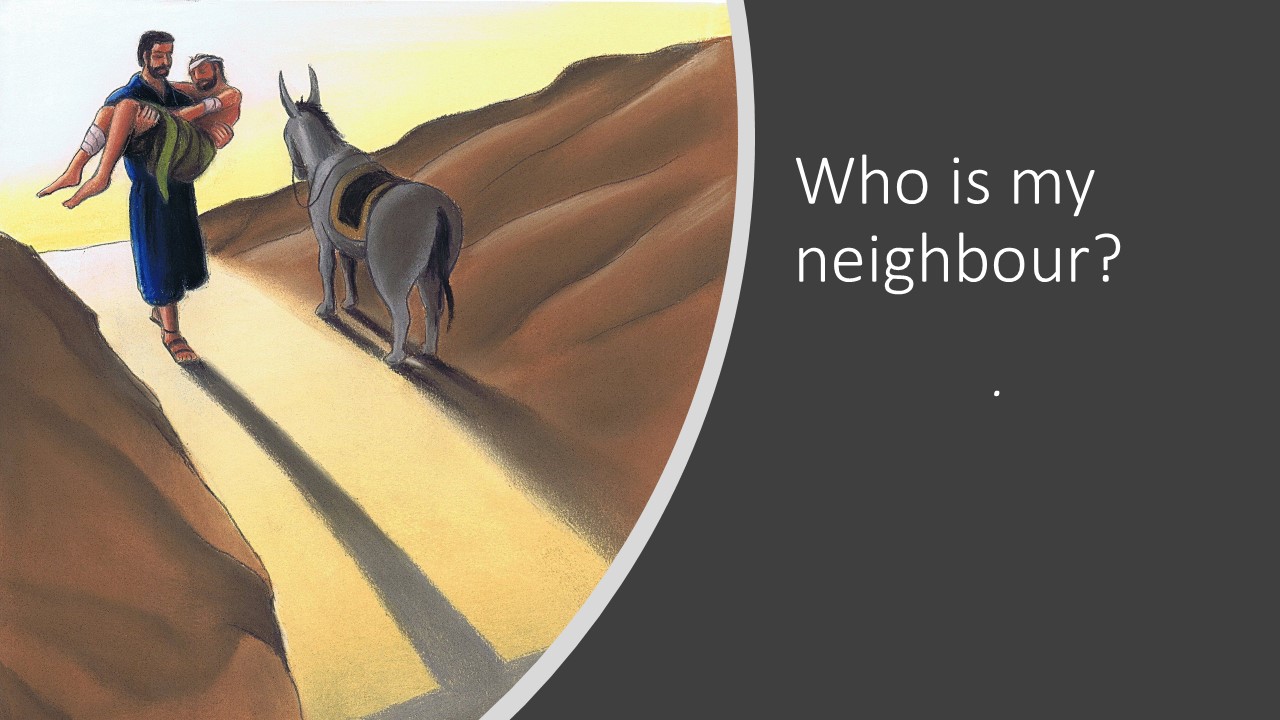
The Good Samaritan

By mmayer
Luke 10: 25-37

On one occasion an expert in the law stood up to test Jesus. “Teacher,” he asked, “what must I do to inherit eternal life?”

“What is written in the Law?” he replied. “How do you read it?”

He answered, “‘Love the Lord your God with all your heart and with all your soul and with all your strength and with all your mind’; and, ‘Love your neighbour as yourself.’”

“You have answered correctly,” Jesus replied. “Do this and you will live.”

But he wanted to justify himself, so he asked Jesus, “And who is my neighbour?”

In reply Jesus said: “A man was going down from Jerusalem to Jericho, when he was attacked by robbers. They stripped him of his clothes, beat him and went away, leaving him half dead. A priest happened to be going down the same road, and when he saw the man, he passed by on the other side.

“So too, a Levite, when he came to the place and saw him, passed by on the other side. But a Samaritan, as he travelled, came where the man was; and when he saw him, he took pity on him. He went to him and bandaged his wounds, pouring on oil and wine. Then he put the man on his own donkey, brought him to an inn and took care of him. The next day he took out two denarii and gave them to the innkeeper.

“ ‘Look after him,’ he said, ‘and when I return, I will reimburse you for any extra expense you may have.’

“Which of these three do you think was a neighbour to the man who fell into the hands of robbers?”

The expert in the law replied, “The one who had mercy on him.”

Jesus told him, “Go and do likewise.”

This is such a well-known story. The despised Samaritan is the only one who actually helps the victim. The modern version might have the helper as a recent refugee, or someone on social security with lots of tattoos. The Jewish audience would have been impressed by a good Jewish person who goes out of their way and risks their own life to help someone who might have been a non-Jew. By making a Samaritan the role model of righteous behaviour, Jesus has just given another reason for to crucify him.

For God the barriers of belief, behaviour, gender or sexuality don’t stop God’s compassion and help for someone in need. He calls each one of us, in our own ways, to put love into non-discriminating action.

Under all that is the deeply loving acts of Jesus, who gave himself up to death on the cross, that we might receive the gift of forgiveness, and the gift of knowing that God is with us, no matter what. Jesus keeps binding up our wounds, and cleaning us up, so that we can start to heal, and start to recover. Knowing and experiencing that allows us to be compassionate.

For the children’s talk I shared about face-planting off my bike in 2017. We counted up at least 12 people who helped me, and I sure needed that help (including 1 ¾ hours with the facial surgeon). At least half the helpers were unpaid. When have been the times that you were in trouble, and received help from unexpected people? We have a God who provides help in so many different ways. I’m sure that you have also helped many. Keep it up, as you are able.

Accessibility