When misusing Christian freedom becomes a faith issue. Corinth, Greece, 50 CE.

By mmayer
1 Corinthians 8:1-13

Now about food sacrificed to idols: we know that ‘We all possess knowledge.’ But knowledge puffs up while love builds up. Those who think they know something do not yet know as they ought to know. But whoever loves God is known by God.[a]

So then, about eating food sacrificed to idols: we know that ‘An idol is nothing at all in the world’ and that ‘There is no God but one.’ For even if there are so-called gods, whether in heaven or on earth (as indeed there are many ‘gods’ and many ‘lords’), yet for us there is but one God, the Father, from whom all things came and for whom we live; and there is but one Lord, Jesus Christ, through whom all things came and through whom we live.

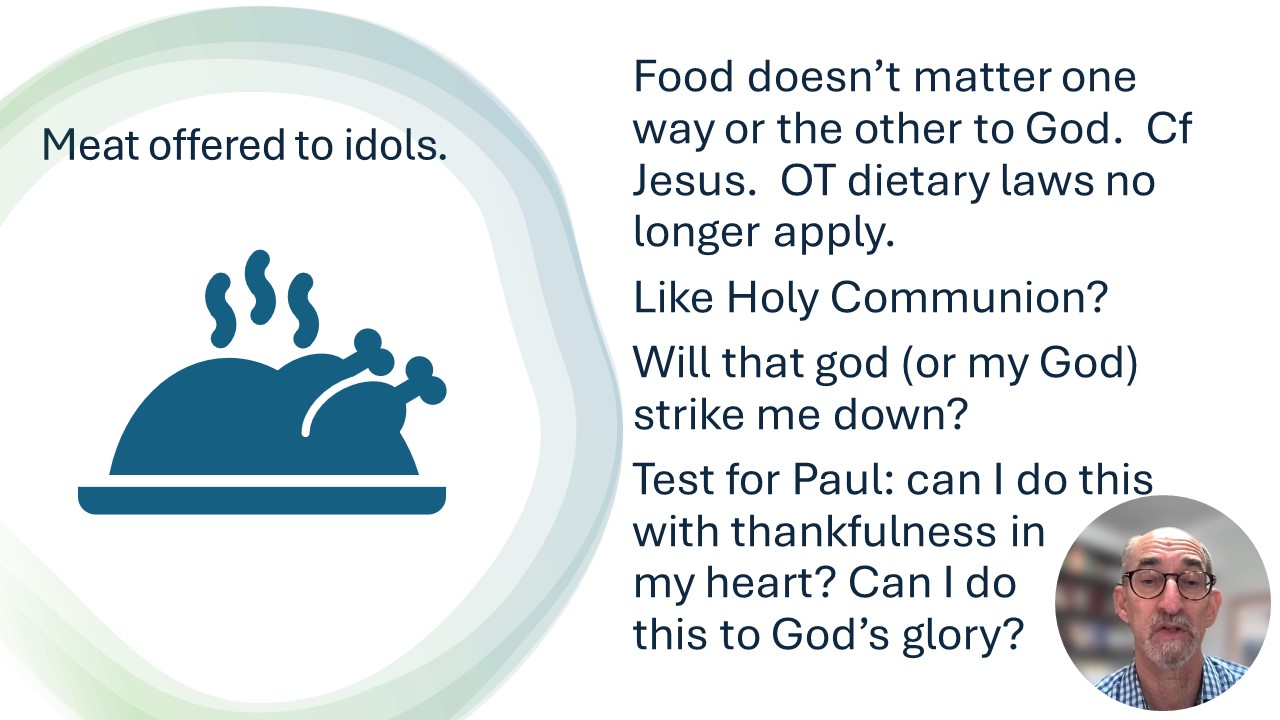
But not everyone possesses this knowledge. Some people are still so accustomed to idols that when they eat sacrificial food they think of it as having been sacrificed to a god, and since their conscience is weak, it is defiled. But food does not bring us near to God; we are no worse if we do not eat, and no better if we do.

Be careful, however, that the exercise of your rights does not become a stumbling-block to the weak. 10 For if someone with a weak conscience sees you, with all your knowledge, eating in an idol’s temple, won’t that person be emboldened to eat what is sacrificed to idols? 11 So this weak brother or sister, for whom Christ died, is destroyed by your knowledge. 12 When you sin against them in this way and wound their weak conscience, you sin against Christ. 13 Therefore, if what I eat causes my brother or sister to fall into sin, I will never eat meat again, so that I will not cause them to fall.

At the time of St Paul, you bought your meat from the market place, but it had all been slaughtered at a nearby temple by a priest who had dedicated that meat to his god. For most Christians in Corinth, they knew that those ‘gods’ were not real like the Christian God was, and most happily ate meat, giving thanks to the Christian God. But still, if they were invited to a business meal or the celebration of a friend, and it was held in the dining room of a temple: that caused issues for those who weren’t so secure in their Christian faith. The problem for them was that it could drag them back into worshipping the old gods they had previously worshipped. It could also drag them back into a life ruled by old fears and worries.

When some Christians figured that their freedom to eat meat was far more important than the well-being of their Christian brothers or sisters whose faith wasn’t so secure, Paul had strong words to say.

Knowledge is important, but not if it puffs the person up (1 Corinthians 8:1) and they then ignore others. Of course Christians are free to eat meat if they choose, even meat dedicated to other ‘gods’, who are really no gods. But the vital thing is to show love to your Christian brothers and sisters, whose faith may not be so secure as yours. If your freedom causes them to sin, then you have sinned against Christ (1 Corinthians 8:12).

So don’t use your freedom in a way that damages others. Paul said that if his freedom to eat meat caused weaker Christians to fall back into worshipping other gods, then he happily ate vegetarian. Sometimes it’s the right thing to forego your rights and freedoms for the sake of others.

Accessibility