
Three things today: we recognise and act on catastrophes, we don’t recognise and act on the things that change slowly.
Prophetic actions.
Wait and see.
- Our brains are wired to recognise and deal with catastrophes, better than with slow, incremental change. Something goes wrong suddenly, we work on it. Bushfire, flood, pandemic. Something changes slowly – we don’t usually see it or act on it. Think of the events that surfaced in Canberra in the last month.
We don’t see slow positive change. A young person quietly works on doing something better, we don’t see it. We don’t see slow downhill decline. Something changes slowly in our health, we just keep going. Things slowly get worse, and it’s a real shock to look at ourself or something we are part of and think, ‘How did it end up here? That’s not really who I am. Or, ‘Maybe I do need to see the doctor.’
The temple in Jerusalem was a place of slow change, slow change downwards. The whole idea of temple as the unique place where the God of Israel met with his people was gift. The sacrifice system was a way to deal with human sin and still have God stick with them. Gift. But the human response side had got things turned the wrong way. Instead of following commands and worship guidelines as a grateful response to God’s grace and mercy, it became – we do all these things to keep God happy, and to be right with God. Luther would say, that’s the way our brains are wired. That’s the way we humans instinctively think – I have value because I achieve. I have to prove my worth to God and to others.
The temple at Jerusalem wasn’t purely a special place to worship the God of Israel. The Temple was the major business for the city, and of course there were tensions between the Roman authorities and the Jews about who controlled all that wealth. The appointment of the High Priest was a careful juggling act between Rome and the Jewish people. There were dynasties of priestly families whose sons got to be High Priest. It was a beautiful place, a godly place, but there was a lot overlaying that. Slow change downwards. Immense pressures. Hundreds of thousands of pilgrims would gather for the major festivals, like this Passover, where Jesus comes. Other money was often literally unholy, because on the back of the coin was the claim of Caesar to be divine, so there had to be places to change money to something approved that could be put into the offerings. Big business, and you know the pressures and forces that gather around big money. Of course there had to be animals that could be purchased for special sacrifices, for those who had come from afar, or lived in cities with no stock of their own.
- Prophetic act that leads to the cross and Easter, and the replacement of the Temple. Suddenly, Jesus appears, in chapter 2 of John, just after amazing his disciples at the wedding at Cana. There, big stone jars, used to hold water for ritual washings (commanded by God) suddenly held hundreds of litres of wine for a marriage celebration. A pointer to something very new in Jesus. Jesus replacing previous rituals that gave life and meaning with what? Himself and his gifts of life.
Jesus, amongst hundreds of thousands of pilgrims does a powerful prophetic act.
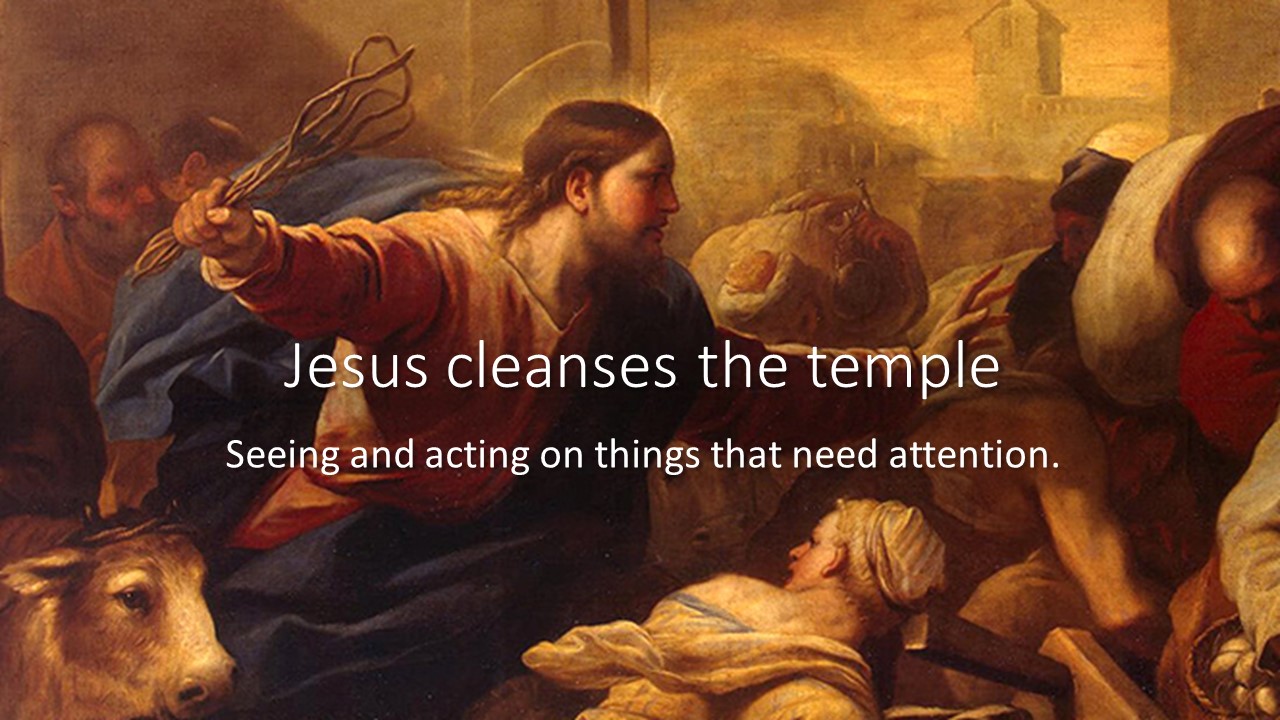
He marches in, makes a whip, and drives out animals and stall holders who are doing their job – helping visitors get the right money for an offering or to purchase an animal to sacrifice. You can imagine temple security rushing around, getting a senior priest to come and stop Jesus, worrying that the Roman guards looking down on them might think this is a Jewish revolt starting, and step in and take over their temple. Jesus speaks: ‘Stop making my Father’s house an emporium, a shopping centre.’
Chaos: animals on the loose, stall holders trying to gather up their money off the ground, overturned tables, shouting, complaining. But also the genuine question: Is this a prophet from God? So, they ask for a sign, and get no sensible answer, ‘Destroy this temple and in three days I will raise it up.’
This prophetic action sets things in motion, leading to new life for us all in the most unexpected way.
The stall holders say, ‘I’m just doing my job. I’ve got to make a living. Someone has to help visitors get the right money, provide the right animals.’ The priests say, We’ve got to hold this all together, we have to compromise with the Romans to ensure the temple survives. Later, in John chapter 11, as the crowds are building around Jesus, who has just raised Lazarus from the tomb, the ruling council is seriously concerned that the Romans will step in, and will destroy, quote ‘both our holy place and our nation.’ Unquote. The high priest replies, ‘It is better to have one man die for the people, than have the whole nation destroyed.’
Jesus knows that the temple way of ding thigns is past. He replaces it with his own body, sacrificed on the cross for us and for all our sins. Out of the catastrophe of his death, there comes forth new life for each one of us. He connects us to our heavenly Father, not through a place, but through his body, and his blood, freely sacrificed for us, once and for all. In this week’s bulletin, Tony reminds us that the temple in the New Testament is people, not a physical place in Jersualem. It’s all the believers in Christ, built together as living stones. In the catastrophe of the temple in Jerusalem being destroyed in the year 70, Christians, both Jewish and non-Jewish, discovered that their worship went on in their local places, and Jesus was with them, as he had promised, to forgive, to bless, to heal.
How often have we thought: I’m stuck. It’s just the way things are. I can’t make a difference. Nothing will ever change. The system is too big. Don’t fall into despair. Breathe, trust, hope. Underneath all, including our inabilities to get thigns going, the Holy Spirit is working: sowing seeds of grace, sowing seeds of positive rebellion, sowing seeds of discontent with what is, and yearning for what can be, sowing seeds of faith, hope and courage. Joining you together with one or two others at the right time to act for good change. Helping you to express discontent with what is, but in a way that can be heard and can bring change.
- Finally, wait and see. In college I used to be part of what was called collaboration, later, pastoral care and well being. The head and deputy head of the sub school, the chaplain, the counsellors, the year level coordinators would meet fortnightly, looking at names of students who needed some attention. Sometimes there were obvious things to attend to. At other times it wasn’t clear that adult intervention or support was needed – that was labelled, wait and see. We’ll check in about this student in a later meeting, to see what has developed.
Wait and see. We’re not good at seeing slow change, either up or down. Deliberately take a step back for a moment. See the positive signs in those around you. See also what is not right, and then ask the Holy Spirit to guide you as to what to do. Wait, see, then act. All the time built on the foundation of Jesus, his love and forgiveness. May the Holy Spirit lead us into all truth and love, in our seeing this week.
