
The Scapegoat
Good Friday sermon. 2021
There is a board game called Scapegoat. In the game you try to get the crime pinned to someone else, while avoiding the blame yourself.
Blaming others is as old as Adam. Literally. Adam stood around and said nothing while the snake worked flat out to trick Eve. They fail the test, eat the fruit and then realise the enormity of what they have done. So they cover up and hide. God calls them out and Adam…….refuses to accept any responsibility. ‘The woman you put here, she gave me the fruit.’
Scapegoating is about avoiding any responsibility and blaming something or someone else.
When you were little, and did something wrong, which you knew was wrong but couldn’t stop yourself – and you got caught – did you ever try the line, ‘The devil made me do it.’ I think I got a very careful talking to from my mum.
The term scapegoat is actually a Bible word.
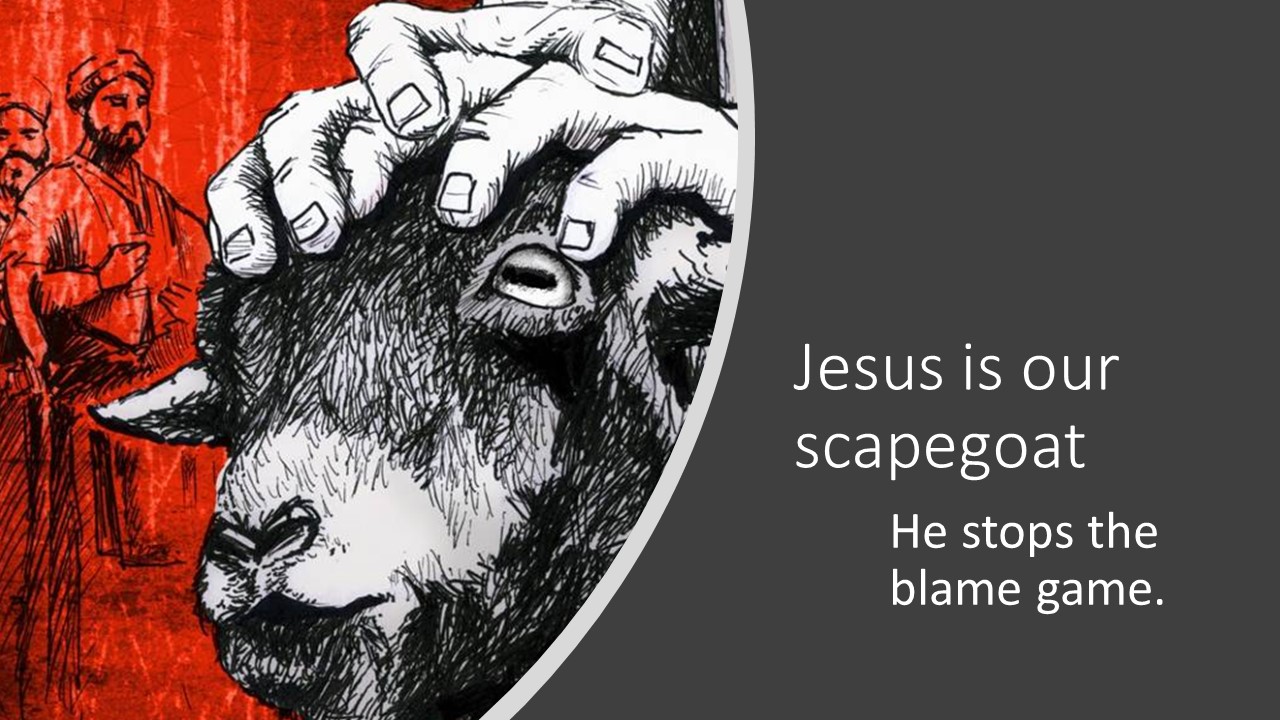
In the Old Testament, in Leviticus chapter 16 we read what happened on the Day of Atonement, the big day when the people faced all their sins over the past the year. The High Priest has accumulated the guilt from all the sins of the people over the year by eating his share of their sacrifices. Once a year he had to offer a bull for his own sins, and then took 2 goats. He took the blood of one into God’s presence to cleanse the holy of holies from the accumulated sin of the people, so that God could still stay in their midst and forgive them. The second goat wasn’t killed. “When Aaron has finished making atonement for the Most Holy Place, the tent of meeting and the altar, he shall bring forward the live goat. He is to lay both hands on the head of the live goat and confess over it all the wickedness and rebellion of the Israelites—all their sins—and put them on the goat’s head. He shall send the goat away into the wilderness in the care of someone appointed for the task. The goat will carry on itself all their sins to a remote place; and the man shall release it in the wilderness.
That was the scapegoat – carrying the sins of the people. That was the mechanism given to them by God, for dealing with guilt – speak it on to an innocent goat, who carried it away.
Here is a Holman Hunt artwork. He mentions the Bible verse in the frame.
Who do we as a nation, state or a church blame for the problems we experience? In the 1950s in was the communists, then it was longhaired students in the 60’ and free love, then it was dole bludgers, then it was rogue businessmen, then it was…..the list goes on and on. Who are the scapegoats in your family, or in your workplace? If you work or live with someone who refuses to take any responsibility for something going wrong, or who is out to target you to make them look good, then you are in a very challenging space, maybe even a dangerous space.
Let’s turn our attention to Jesus.
And that is Jesus for us on this day – the scapegoat. He is the one who caries all our sins, he is the one pushed out of the city, he is the one who is treated as rubbish, and disposed of, and he went willingly. In his ministry, like happened with the scapegoat, Jesus had loaded himself up with human sins and sicknesses by being with people, and not pushing them away. He reached out to unclean people, he touched dead people to call them back to life. He mixed with people whose lifestyles meant they were not allowed to go to church. In doing all that, he took it all onto himself and he took it all to the cross. In doing that he was saying: the evil stops here. Revenge, no matter how righteous – stops here. Blaming others stops here. Bitterness stops here. Attacking others stops here.
We all have our issues, our hurts, our personal stories of wrongs done to us. We may also be aware of how our attitudes, our judging, our actions have not always blessed others. The power of transformation happens for us, as we learn to entrust ourselves into this space with Jesus. We learn to stay with our issues, not in a morbid or depressing way, but to allow the healing work to happen in us. We are taken deeper than the instinctual cycle of attack and counter-attack, or blame and deflect. We are able to not immediately cover up our wrong doing, but let it gently be opened up to the compassion and care of our Lord. And when we come to realise how we have been mistreated by others, or by situations, we are taken through our feelings of confusion or shame, then we are taken past our righteous anger, to a deeper place, where we learn to respond out of love, and not lash out in hurt. Here, at the cross, we start to find some sort of peace, and the power to live in a good way, with the things inside or around us, that are not yet right, but are being worked on in a good way.
Jesus is the true scapegoat. He does not take everything away from us so we never have to deal with it again. Neither does he continually rub our faces in our messes. He holds us compassionately, and in truth and picks us up. He speaks words of truth to us, truth that heals.
We may have a lot of scarring, but those scars now become badges of honour, places where we have done the painful, honest, hard work, that has brought healing and hope to us.
