
Christ humbled himself, and became obedient unto death, even death on the cross. Traditional part of the Lent liturgy, sung as a response to the second reading. Simple words, but full of a different sort of power to what we are usually attracted to. Philippians talks about the journey down, for Jesus, and the journey up.
The journey down: not staying safe in heaven, remote from the messiness and the pain of our ordinary lives. He became one of us, human, deliberately choosing to be a slave, a servant – someone whose whole life is dedicated to others. For Jesus that servanthood meant willingly joining us in death. Not a sweet death, after a long and well-lived life, farewelled by loved ones. His death was that of a slave and a prisoner, with no human rights. Dying in darkness and shame, abandoned by all, even his God. A total letting go, a total humiliation. That is Jesus for us, as we move in to this Holy Week.
In Bible language we talk about him being an innocent sacrifice, who takes away the sin of the world. Our lack of being right and doing things right gets placed at the foot of the cross and left there. We are invited, commanded, loved, cajoled, into allowing our sin and brokenness, our shame and imperfections, the wrong things we have done, the evil done to us – allowing them to be left there, and covered over with forgiveness and deep godly compassion. It’s the ultimate detox, and it takes a lifetime sometimes, before we ‘get it’.
That is the journey down for Jesus, into death, into hell, for us. At the very worst moments of our lives, there is Jesus, perhaps being revealed as one flickering light in our darkness, saying, come this way. Perhaps as a full-on jackhammering, breaking through the reinforced concrete we are trapped in, because that is the only way that is going to get through to us in the space we are in.
The journey up: because of Jesus’ utter faithfulness, his Father lifts him up, out of slavery, out of darkness, out of failure, out of death, out of the Holy Saturday tomb. But this time we know Jesus is different. He has literally experienced everything we go through. He has taken everything of us into himself, in love, compassion, healing, hope. And that shows, as the Easter Jesus reaches out to each one of us. You are never too old, too hopeless, too messed up, too boring for the Holy Spirit to take you and all that you are, and lead you into new ways of living and being. Our Bible text tells us that every knee will bow, in heaven, on earth, and under the earth, and every tongue confess that Jesus Christ is Lord, to God’s glory.
I want to apply this journey down, this being lifted up in two ways.
- You are not in control.
- Letting go.
- You are not in control. That was one of the 5 big things from the men’s work I was part of 10 years ago. Last week we worked with another big one: ‘You are going to die’. Jesus said that a single grain of wheat remains just a single seed. When it dies, by being planted, then it grows and bears much fruit. So our lives are all supported and covered in Christ. but underneath that was the message that we too must go on this downward journey, in order for our lives to be fruitful.
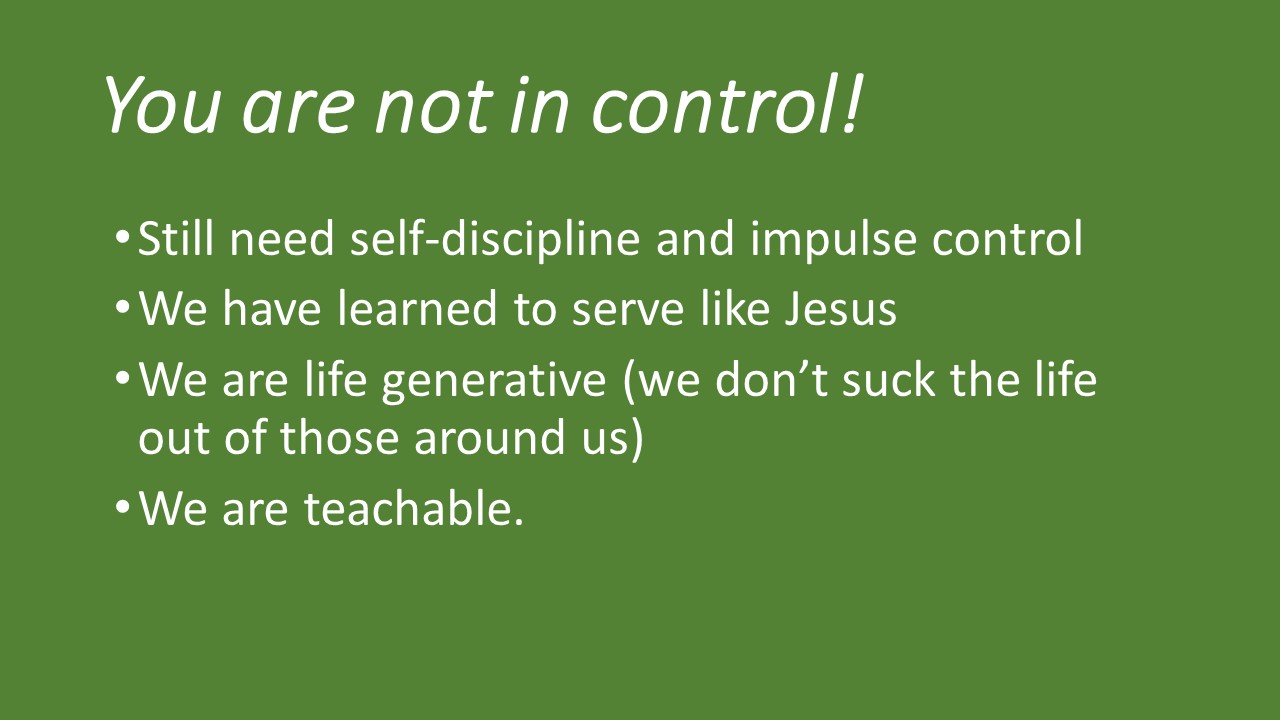
You are not in control. That does not mean we don’t insist on self discipline and impulse control for children, teenagers, young adults and ourselves. Those are vital learnings. Good teachers set high expectations and high standards. We see the lack of standards playing out in parliament house culture last week. People having exercised their power in very selfish, belittling ways and in so doing, have made themselves tiny. You are not in control. Until you have learned that big lesson, you are not ready to use your power for good. We do not have to have everyone around us doing our will all the time. Not everything has to go our way. We can’t make our lives totally safe or totally happy. Probably the more we insist, the less happy we get. The more we try to be less anxious, the more anxious we get. You are not in control. That does not mean we put up with abuse from others. There are times when we do need to act very deliberately and remove ourselves. But we can’t control the big things – we can’t be super successful, super rich, super amazing, super liked, super healthy for ever. Our lives are joined to Jesus. There is a deeper purpose. We are called to learn to serve – to develop our talents and gifts, to not just live a life of ease that’s all about us. We are called to be people who are life generative for others. We are called to grow to be a person who enriches and gives life to others, rather than draining life out of everyone we meet. If our needs are so big and get in the way, we do the hard work of attending to them and learn to do things differenlty, rather than insisting that others rescue us all the time. The good news is that our failures and our falls become places where Jesus can break through, help us to learn something deeper and more godly, that we never would have got without that hard experience.
I think, in healthy parenting and grandparenting, there is both that deeply unconditional love, the comforting embrace of love no matter what, and the tough love that firmly calls us beyond what we want or think we can do. We need both unconditional love, and the firm ‘you can do this’ in order to grow. You might like to have a conversation at home about which type of grandparent you are, or what your experiences of being parented were like.
A hundred years ago, German poet Rilke, was watching a big storm move through. He was also thinking about the Biblical account of Jacob wrestling with God. He said finally, we need something much bigger and better than us to be tested against. Here is what he wrote.
‘How small are the things we choose to fight.
What fights us is so great!
If only we could let ourselves be overcome,
as nature is overcome by a great storm.
Because if we do win, it is a small victory,
and the victory itself makes us small.
Whoever is defeated by an angel
always goes away proud and upright, full of strength,
and greater still for having felt his power.
This is how we grow:
by being decisively defeated by ever greater forces.’
So – you are not in control, but your heavenly Father is, and we learn to entrust ourselves and all that is important into Fatherly care. We do learn to grow by being defeated by God’s great forces of love and truth.
- Letting go. That’s what Jesus did – he let go the safety and security of being God’s Son in heaven, in order to heal us and this world. Part of our life skills is learning when and how to let go in order for a deeper life to happen in us and around us. I think that would be a very good reflection exercise this week, to prayerfully ask, “What do I need to let go of in order to be more my true self, the person you see and love and desire?
Letting go for a Christian means letting go to God. Allowing God to carry my pain or hurts, my hopes or dreams. Maybe there are rules I live by, or secret vows I made to myself that were vital for my protection when I was a child, or a teen, or in my 20’s or 30’s, but now they are stopping me live my life freely. Letting go. Allowing God into some of my worst experiences or moments of shame. Holding them less tightly or with less self-condemnation. Letting go so that I can be lifted up in ways I never expected. Lifted up in God’s love.
